Be the Mean Lawyer: My Approach to Reading Comp

The hardest part of the SAT, for me, has always been reading comprehension. Not only am I a slow reader, but my ability to grasp what is really going on is often dependent on the subject matter and how interesting or familiar I find it.
I am very upfront with the fact that this area is not a natural strength for me, but it is something the SAT tests - a lot. And as an SAT tutor, sometimes students expect me to be able to help them in this area.
Anyways, after considerable trial and error trying to improve in my accuracy, as well as reading the books and blogs of some other SAT tutors, here's the approach I've developed what I call the "mean lawyer approach".
The number one priority is to take your time to understand the passage as well as you possibly can - it's okay to take 90 seconds just to read the passage. The idea is to make the time back on simpler question types like grammar, transitions, bullet points, and fill in the blanks.
Most students will read a passage and set out to look for the right answer to a question. The problem is often 2 or more answers will look right. They may contain elements that are correct or be appealing in different ways. They are designed by the College Board to do exactly that.
We must remember that because the College Board doesn't want a big 'ol lawsuit, the answers must be as objective as possible, so every wrong answer must be wrong for some tangible reason. Our goal is to find 3 wrong answers. Here's how it looks in action:
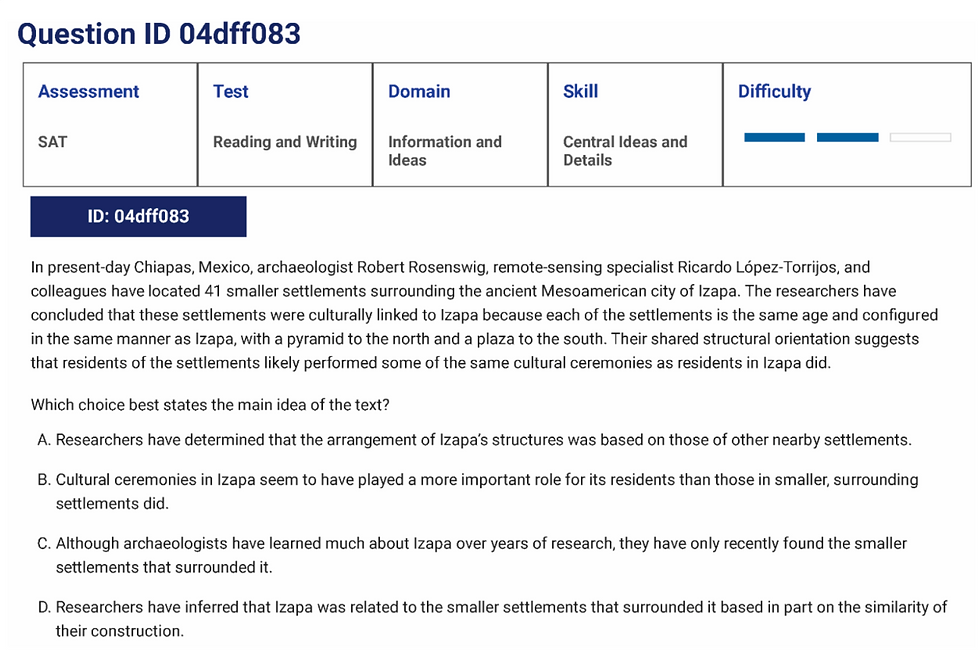
Read the passage and try to summarize it in your own words.
Here goes nothing:
Somewhere in Mexico, an archeologist and some other dudes found some settlements around an old city. They concluded that the settlements were connected to the city because of the age and layout. The shared layout means the people probably did some of the same ceremonies as in the big city.
That's about it - hopefully that's enough to answer our question. Notice how I basically skim past names of people and cities. In case you thought otherwise, I'm not too familiar with ancient Mexico or archeology, so the simpler I can make it in my head, the better chance I have at actually answering a question.
By the way if I were to give a one sentence summary on the main idea, without reading the answers, it would be something like: researchers found that settlements surrounding this old city had a similar age and orientation to the city, so they think there was a cultural connection there.
It's okay if I'm wrong - my goal is to find wrong answers, not right ones.
Try it yourself - look at the answer choices and try to pick out 3 that are clearly wrong.
Choice A: Clearly Wrong. What makes it wrong? It says that the main city's structures were based on the surrounding settlements. It simply never says that in the text. This is a classic answer that takes something that is almost correct (the city and surrounding settlements have a similar structure) and then adds a complete lie.
Choice B: Clearly Wrong. Yes, it mentions some stuff about cultural ceremonies, but it never says who it would be more important to. Again, this answer is making up a bunch of baloney. We don't have time for this garbage.
Choice C: Wrong. I avoided using the word "Clearly" here because this one is a bit more subtle. The issue is that there is no indication that the main city (Izapa) was the subject of research for many years. Also, even if this were true, it's certainly not the main idea of the text. It's more like context for the true findings.
Choice D: Not Wrong. This is fairly similar to my one sentence summary (promise I didn't cheat).
What we are doing here is not about speed, it's about accuracy.
We'll do one more example to further illustrate the point, but then you should run wild and apply it to your own practice.
I also want you to note that although the summary of the passage in my own words was exceptionally crude and cut out some less important details, it was completely sufficient to answer the question confidently. The only time I looked back at the passage was to confirm that Izapa was the name of the big city :)
Example 2:
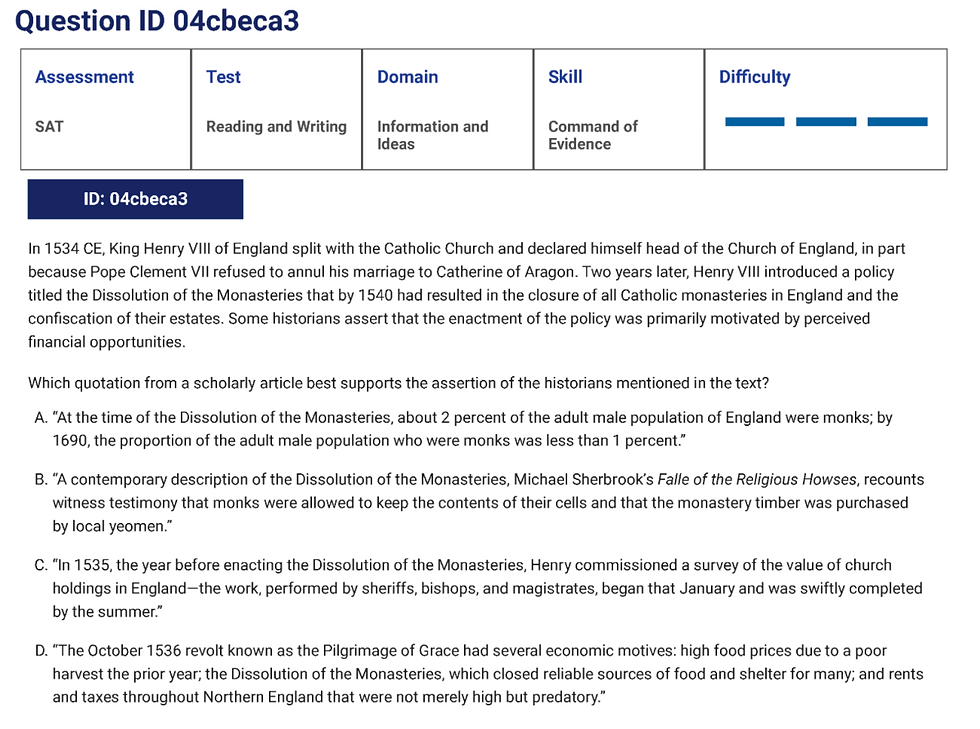
I decided to give myself a hard one - never seen it, don't know the answer.
Glancing at the question before reading never hurts. It's what I like to call a "which if true" problem, which basically asks which piece of information would be most helpful/hurtful to something from the text.
First, we summarize in our own words:
A while back, the King of England left the Catholic Church and called himself Pope - partially because he wanted a divorce. Then he created a law that closed all monasteries in England and took their property (note: I'm not 100% sure what a monastery is - guessing something like a church. We'll see if it matters). Some historians think he did this for financial reasons.
Done. Aside from knowing what a monastary is, I feel like I have a pretty solid understanding of what happened here. King wanted out of his marriage, but Catholics aren't into divorce, so he decided he would become head of the church instead. Then he closed all the legit Catholic churches (monasteries) and historians think he did this for the money.
The question asks which quote supports the idea that the King closed the monasteries for financial opportunity.
Aside: You may notice I don't repeat the question verbatum. This is intentional. The biggest meta-skill on these dense reading passages is being able to summarize things in your own words on the fly. There's too many odd details being thrown at us. Like I don't care that these quotes are from "scholarly articles". That's utterly irrelevant, so I just skim over it. And you should too!
So we're looking for some evidence that he did this for the financial opportunity.
Choice A: Totally bogus. It's all about how many people are monks. Remember, the claim is that the King closed the monasteries for financial reasons.
Choice B: unclear, but leaning no. This one mentions some forms of commerce, like timber being bought by local yeomen (what the heck is a yeomen??). I've only read choices A and B so far, and B is the type of answer I'm only clicking if C and D both suck. It's a tentative no, but it's definitely better than A. I'm not crossing it off with pen just yet.
Choice C: This is quite strong. King Henry dug into the value of the churches before closing them and seizing the property. If nothing else, this is incredible circumstantial evidence. I'm very comfortable eliminating Choice B at this point.
Choice D: This looks like a trap answer if I've ever seen one. It uses the language of "economic motives" that is eerily similar to "financial opportunities" by the historians. But the answer itself is not about the Dissolution of Monasteries. It's about some revolt that seemed to be in response - in part - to the monasteries closing. It has nothing to do with our question.
Therefore, we can confidently say the answer choice is C.
Looking back, my summary didn't include any years and some of the answer choices did. It's pretty easy to glance back at the passage if the years become a relevant point. In this example, choice C told us that 1535 was the year before the Act, so we didn't have to look back.
I truly believe this general approach of interrogation answers and looking for 3 wrong answers is one that you need to practice in order to implement it well. The skill of summarizing text into your own simple words and doing the same with questions and answer choices is critically important.
Godspeed my friends.