How I approach "Structure of the Text" SAT Problems

This blog post has a modest goal: make the “Structure of the Text” problems so gosh-darn easy that you’d have to be drunk out of your mind to get one wrong. And also, let’s try to get them done in about a minute or less, so we have plenty of time to doodle on our scrap paper before submitting our work.
Good. The goal is clear.
First things first: what am I talking about when I refer to “Structure of the Text” problems.
If you’ve done some SAT practice, you may already know that they are the problems in the “Craft and Structure” portion of the Reading and Writing section. This is usually around problems 1-8 of each Reading and Writing module. You’re likely to see 2 or 3 of them on a given SAT.
Example 1:
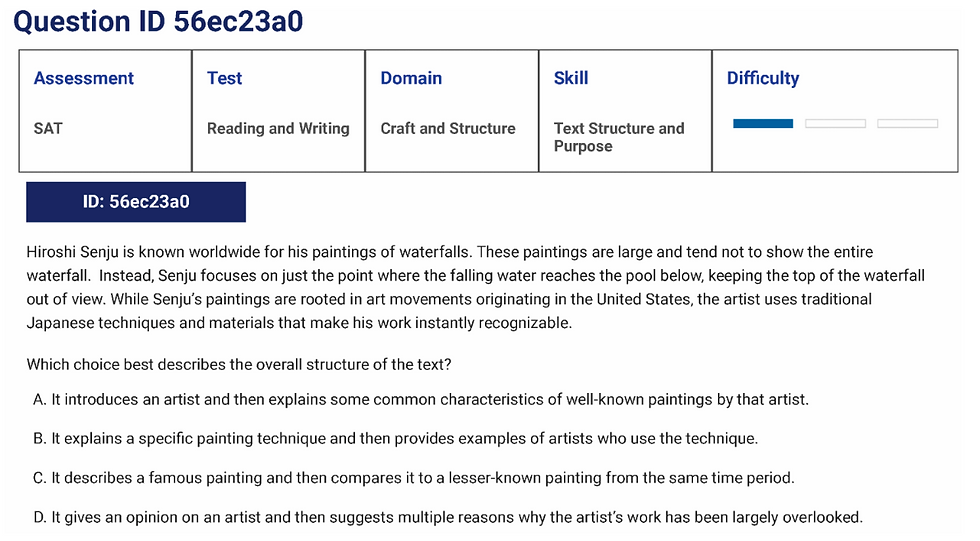
Before digging in to the text and trying to figure out the right answer, I want to point out some common features of this problem type:
The answer choices follow a predictable pattern
“The text does A” “and then” “the text does B”
The order of events A and B in the answer choices correspond to the order the information is presented in the passage.
Now that we understand the general structure of these problems, the following observation is important:
The answer choices break the text into 2 or 3 chunks and summarize each chunk.
Idea: Let’s just read the first part of the text and then read the first part of each answer choice and see which one fits.
Going back to the first example in the screenshot above, let’s follow some simple steps:
Step 1: Read the first sentence of the passage
Hiroshi Senju is known worldwide for his paintings of waterfalls.
Step 2: Summarize what’s going on in the first sentence.
We’re introduced to an artist and what he’s famous for.
Note: your summary may differ from mine, which is fine. Try to focus your summary on broadly what the text is doing, without focusing on names or details. These questions don’t focus on details in the text, they focus on structure.
Step 3: Evaluate the first part of each answer choice against our summary.
It introduces an artist - this is almost exactly what our summary says
It explains a specific painting technique - this has nothing to do with our summary
It describes a famous painting - it says what he’s famous for, but doesn’t mention a specific painting
It gives and opinion on an artist - No opinion is expressed
Step 4: If you have a clear answer, choose it, and don’t look back. If not, read the next chunk of text and repeat this process.
Here, the answer is clearly choice A.
Let’s repeat this process with a medium difficulty problem and see if the strategy holds up.
Example 2:
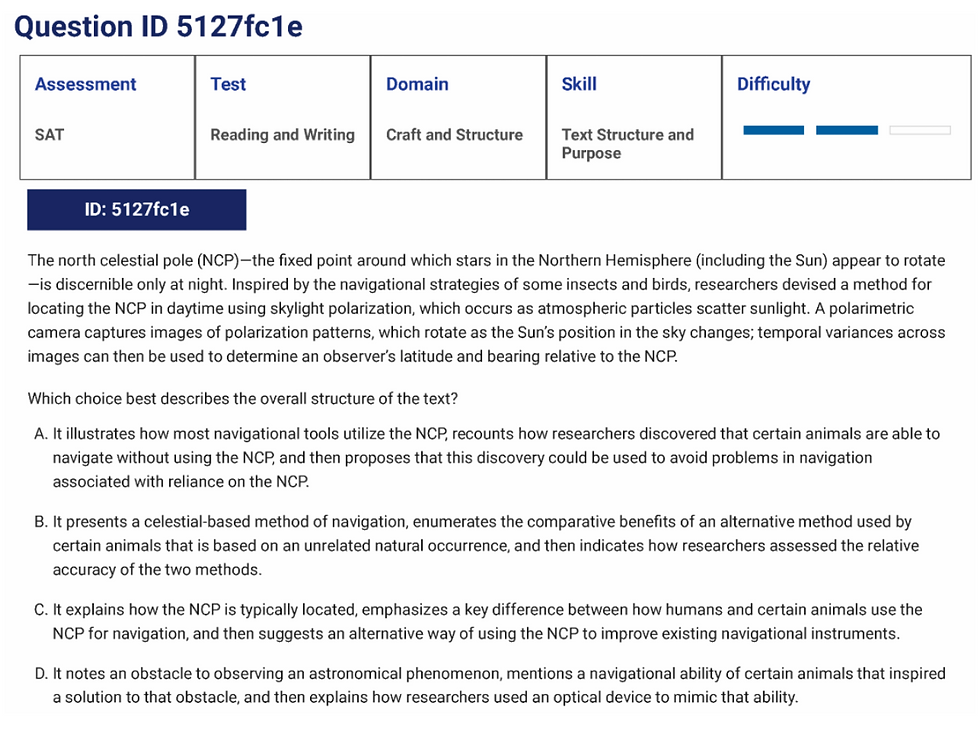
Before embarking on our steps, observe that this time the answer choices are broken into 3 chunks, not 2. We have “The text does A, B” “and then” “the text does C”.
Will this make a difference in how we proceed? Absolutely not!
Step 1: Read the first sentence of the passage
The north celestial pole (NCP) - the fixed point around which stars in the Northern Hemisphere (including the Sun) appear to rotate - is discernible only at night.
Step 2: Summarize what’s going on in the first sentence.
This sentence is much more complicated, but we know that 2 dashes in the middle of a sentence are used to indicate unnecessary additional information. We may be able to get away with skipping all of that. That would make the whole sentence just “The north celestial pole is discernible only at night.”
Now we still have some tricky words, so using the information between the dashes may help if you don’t know what celestial means. The gist I’m getting from this sentence is this:
Summary: there’s something in outer space that we can only see at night.
Step 3: Evaluate the first part of each answer choice against our summary.
It illustrates how most navigational tools utilize the NCP - nothing to do with our summary
It presents a celestial-based method of navigation - nope. There’s no mention of navigation at all.
It explains how the NCP is typically located - it actually doesn’t do a single bit of this.
It notes an obstacle to observing an astronomical phenomenon - yes! We can only see it at night. That is indeed an obstacle to observing it.
In case this seems too easy to you, I want to reassure you that it is. The reason these problems just became so easy is that most of the trickery in the wrong answer choices rely on you reading MORE than you have to.
If you had read the whole passage, you may have been tempted by choice B. The second sentence in the passage discusses “navigational strategies”, which may lead you to incorrectly choose B.
The trick to doing well here is precisely in ignoring everything beyond the first sentence unless we are absolutely forced to read on.
Let’s try a hard one to make sure our strategy can handle the heat.
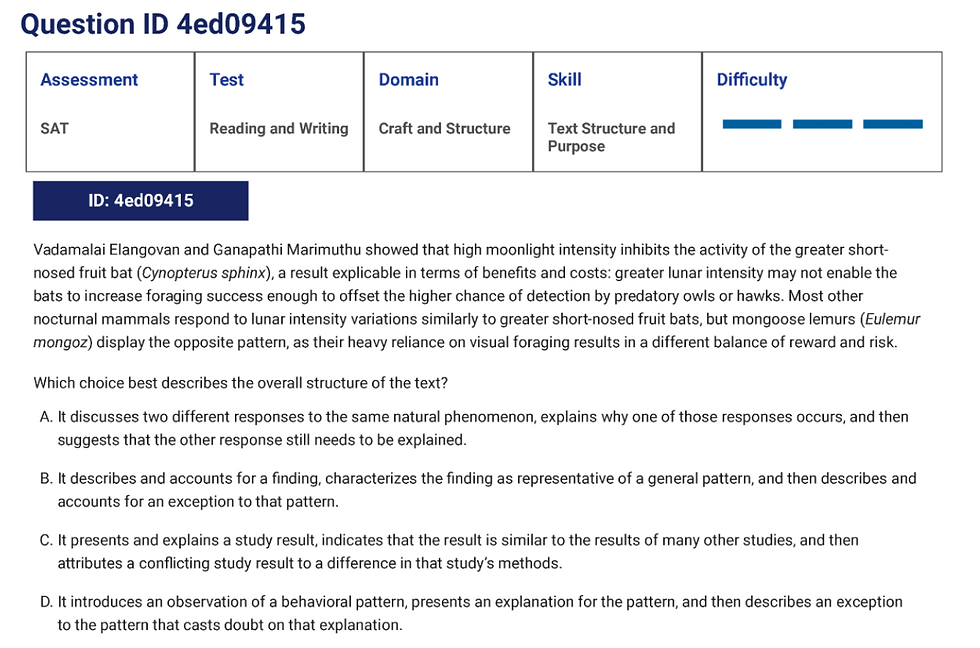
Example 3:
Step 1: Read the first sentence of the passage
Vadamalai Elangovan and Ganapathi Marimuthu showed that high moonlight intensity inhibits the activity of the greater short-nosed fruit bat (Cynopterus sphinx), a result explicable in terms of benefits and costs: greater lunar intensity may not enable the bats to increase foraging success enough to offset the higher chance of detection by predatory owls or hawks.
Step 2: Summarize what’s going on in the first sentence.
2 researchers found that bats don’t go out when the moon is brighter, which makes sense because even though they could get more food, they’re easier prey.
Step 3: Evaluate the first part of each answer choice against our summary.
Note once again that each answer choice has 3 sections: “A, B, and then C”
It discusses two different responses to the same natural phenomenon - not even close
It describes and accounts for a finding - this feels promising since we are describing and explaining the reason for a finding
It presents and explains a study result - this is tempting, but we are never told that this was a study. Color me skeptical
It introduces an observation of a behavioral pattern - this isn’t as detailed, but it’s not wrong.
At this point we can cross off choice A and possibly choice C. Let’s keep digging with the next sentence:
Step 4: Read and Summarize the 2nd sentence:
Most other nocturnal mammals respond to lunar intensity variations similarly to greater short-nosed fruit bats, but mongoose lemurs display the opposite pattern, as their heavy reliance on visual foraging results in a different balance of reward and risk.
Summary: Most animals also stay in when the moon is bright, with the exception of mongoose lemurs because they don’t see as well.
In total, here’s our summary of the passage:
2 researchers found that bats don’t go out when the moon is brighter, which makes sense because even though they could get more food, they’re easier prey. Most animals also stay in when the moon is bright, with the exception of mongoose lemurs.
In essence: we have an observation, a reason for it, a connection to a broader population, and an exception.
It’s important to keep track of the total summary because some answer choices will have 2 points related to a single sentence, as we’ll soon see.
Eliminating Choice A, let’s now look again at the others:
Choice B: It describes and accounts for a finding, characterizes the finding as representative of a general pattern, and then describes and accounts for an exception to that pattern. - This fits our summary beautifully. No notes.
Choice C: It presents and explains a study result, indicates that the result is similar to the results of many other studies, and then attributes a conflicting study result to a difference in that study’s methods. - This answer starts off fine, but goes off the rails toward the end. I was already uncomfortable with all the “study” references that don’t appear in the text, but the last part is the clincher. They attribute the exception to something about the animal, not a difference in study methodology. This is absolutely wrong.
Choice D: It introduces an observation of a behavioral pattern, presents an explanation for the pattern, and then describes an exception to the pattern that casts doubt on that explanation. - This one was also doing great until the last few words. The exception is explained in a way that makes perfect sense. It doesn’t cast doubt on the reasoning for why bats and other animals stay inside when the moon is bright. This is wrong.
Answer Choice B
The key to executing this approach well is writing good summaries of the text. You will find that for easy and medium questions, you will often be able to answer these questions in 30 seconds or less with some practice.
For harder ones, you will often have to read and understand more of the text to get them right. The first pass may be enough to eliminate 1 or 2 answer choices, but a second look will likely be necessary.
In terms of achieving our goals of making these problems “so gosh darn easy that you’d have to be drunk out of your mind to get one wrong”, I’d say we’ve made progress. And that will have to do for now.