How to Solve the SAT Reading Problems that Even High Scorers are Getting Wrong

Questions like “Which finding, if true, would most directly support…” are some of the hardest questions to answer on the SAT.
They are often dumped into the blanket category of “dense reading comprehension questions” that plague so many students and tutors.
These questions broadly ask what quotation or piece of evidence would support or weaken an argument from the text.
I like to broadly categorize them as “which…if true” problems.
Here are a small handful of examples to ensure we are on the same page.

You can see from the above examples that while some of the questions follow the literal structure I’ve put forth of “which…if true…”, others vary, but essentially ask the same question.
Q3 might as well read, “which quotation, if true, would most directly support the assertion of the historians…
Q4 might as well read, “which quotation, if true, would most directly support the curator’s claim?”
At their core, they’re asking for supporting evidence for an assertion or claim.
So let’s talk about how to answer them.
Each question is asking us to reflect on a claim. In order to do that, we need to identify and understand the claim in question.
Step 1: Identify and understand the claim
Step 2: are we supporting or weakening the claim?
This is very basic but critically important to do
Step 3: evaluate each answer choice and pick one!
Let’s try it out on an easy one and see how it goes.
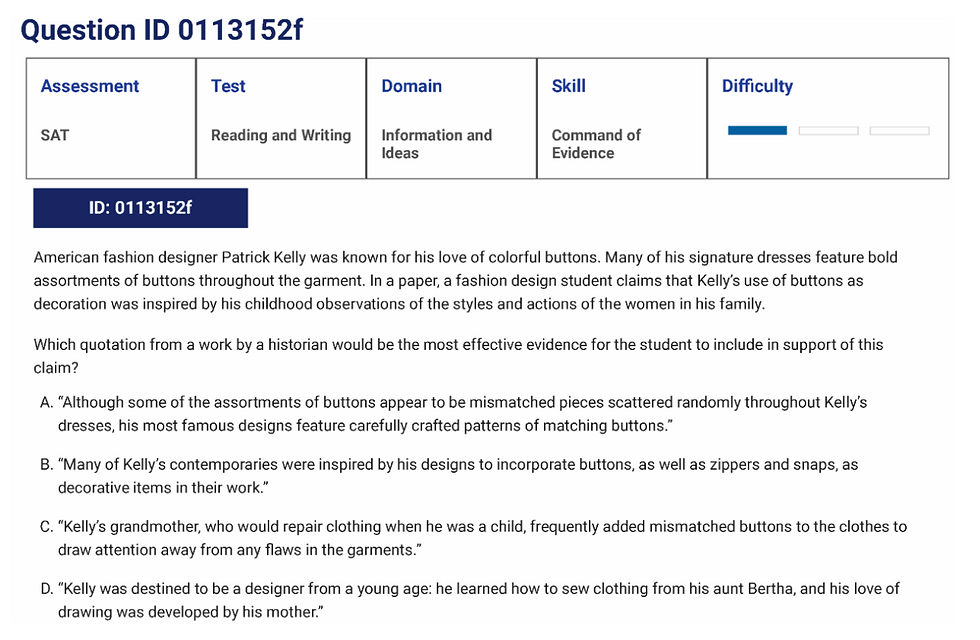
Step 1: Identify and understand the claim
Very often, we just need to scan the text and find where the claim is. Here, I see the words “student claims” in the second line, indicating that this is where our claim is.
“Kelly’s use of buttons as decoration was inspired by his childhood observations of the styles and actions of the women in his family”
To put this in my own words, Kelly saw some female family members do something artistic, and was inspired to use buttons as decoration.
Step 2: Are we supporting or weakening the claim?
The question asks for a quote that will be “effective evidence for the student to include in support of his claim”.
Very simply, we are looking for supporting evidence in our answer.
Step 3: Evaluate each answer choice in its support of the claim:
I’d encourage you to try evaluating each answer choice on your own before reading on.
Choice A: This has nothing to do with the claim about inspiration from female family members
Choice B: This talks about other people being inspired by Kelly, which is not what the claim is at all.
Choice C: This is perfect. It talks about Kelly’s grandmother and the notion of using buttons as decoration to clothing.
Choice D: This is the trap choice. It does refer to female family members inspiring him, but fails to mention the connection to buttons in particular.
Final Answer: C
Let’s try another example, that is a little bit trickier.
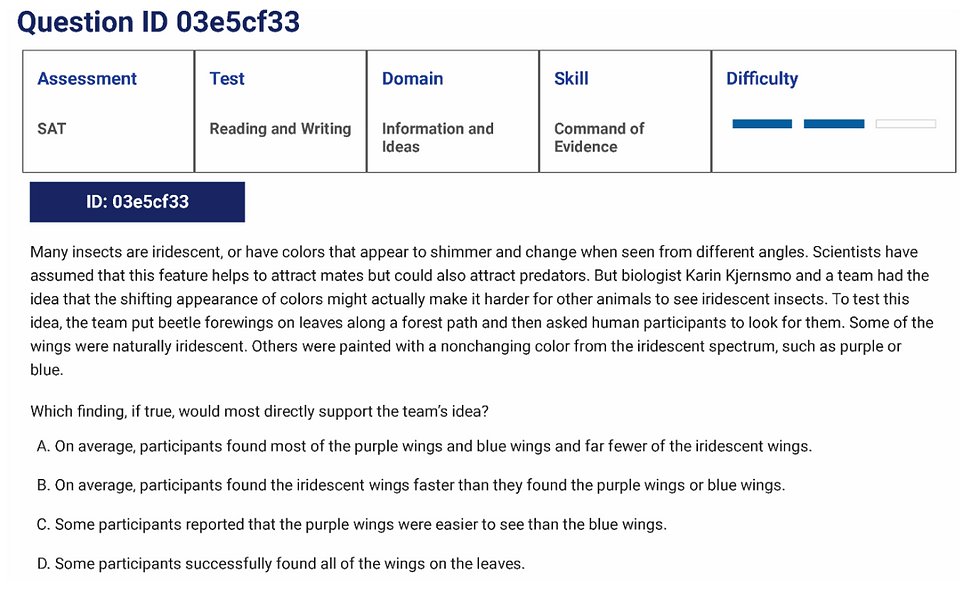
Step 1: Identify and understand the claim
Here, we can see the sentence “But biologist Karen Kjensmo and a team has the idea that the shifting appearance of colors might actually make it harder for other animals to see iridescent insects”
The question asks us about evidence related to the “team’s idea”, so we can be sure we’re looking in the right place.
Now as for understanding the claim, I have no idea what “iridescent” means, but from context it seems like the idea is:
Insects that change color are harder for other animals to see.
The text says “shifting appearance of color”, so they may not literally be changing color, but maybe they’re more like those shiny sports cars that look blue or purple depending on the light.
But I digress.
Step 2: Are we supporting or weakening the idea?
Reading the question tells us we are looking to support the idea.
So we want a finding that supports the idea that color-changing insects are harder to see.
Step 3: Evaluate each answer choice in its support of the claim:
Choice A: we see the word “iridescent” has followed us into the answers. Bummer. From context in the sentence we analyzed, we can tell that its used to describe the insects that are harder to see. Maybe it means something like color-changing. Given that, choice A makes a lot of sense. The claim was that iridescent insects are harder to see, and participants in choice A had a harder time spotting them. Very clean.
Choice B: Exact opposite of choice A. Totally wrong. This is why Step 2 is important - we must remember that we are trying to strengthen or support our idea.
Choice C: this has nothing to do with the claim. The claim doesn’t even mention blue or purple. I’m guessing that reading more of the passage will shed light on why blue and purple are used here, but it’s better to not read all that stuff and just cross this answer off. It’s definitely wrong.
Choice D: This doesn’t support our claim. It draws no distinction between iridescent and non-iridescent wings; again, whatever iridescent actually means.
Final Answer: A
Let’s try one more even harder example:
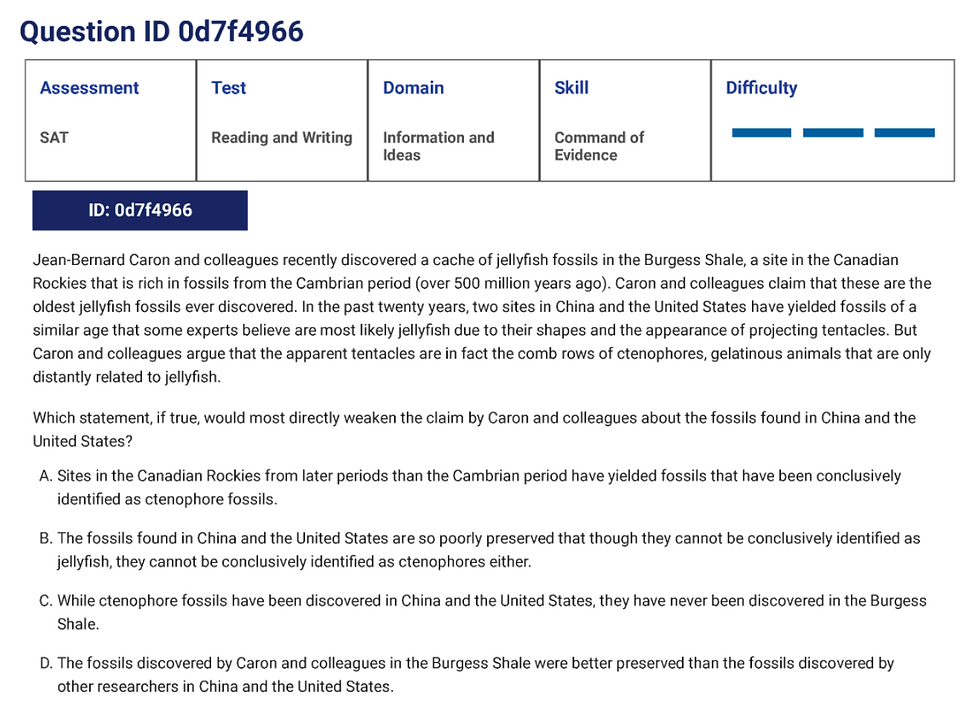
Step 1: Identify and understand the claim
“Caron and colleagues argue that the apparent tentacles are in fact the comb rows of ctenophores, gelatinous animals that are only distantly related to jellyfish”
Don’t worry about understanding exactly what ctenophores are. It doesn’t matter.
Takeaway: they found something that initially looked like jellyfish tentacles, but then determined that they are actually something else that are totally different.
Step 2: Are we supporting or weakening the idea?
The question asks which statement “would most directly weaken the claim.” That’s what we want to do.
So we should be looking for a statement that indicates that what they found actually are jellyfish tentacles - or at least are not comb rows of ctenophores, whatever those are.
Step 3: Evaluate each answer choice in its support of the claim:
Choice A: This doesn’t seem to have anything to do with the claim. If you read the rest of the passage, you’ll get a little more context for this answer choice, which is something you can do after you get your 1600 and are sipping a lemonade on the beach.
Choice B: This is pretty good. It agrees with half the claim that the fossils are not jellyfish, but it weakens the claim by saying that they also cannot be identified as ctenophores.
Choice C: Nothing to do with the claim.
Choice D: Nothing to do with the claim.
Final Answer: B
Wrap Up:
This strategy works well - practice it and make it automatic. It follows a very clear logic: the question is only asking about a claim, so just focus on the claim and nothing else.
Godspeed, my friends.