Transition Problems on the SAT are found toward the end of each Reading and Writing module. You’re likely to find between 4-7 of them between the 2 modules, so getting them right consistently is very important. Below is a general guide that includes almost every transition you’ll find on the SAT and the general role they play. In order to solve these problems consistently, you need to be able to 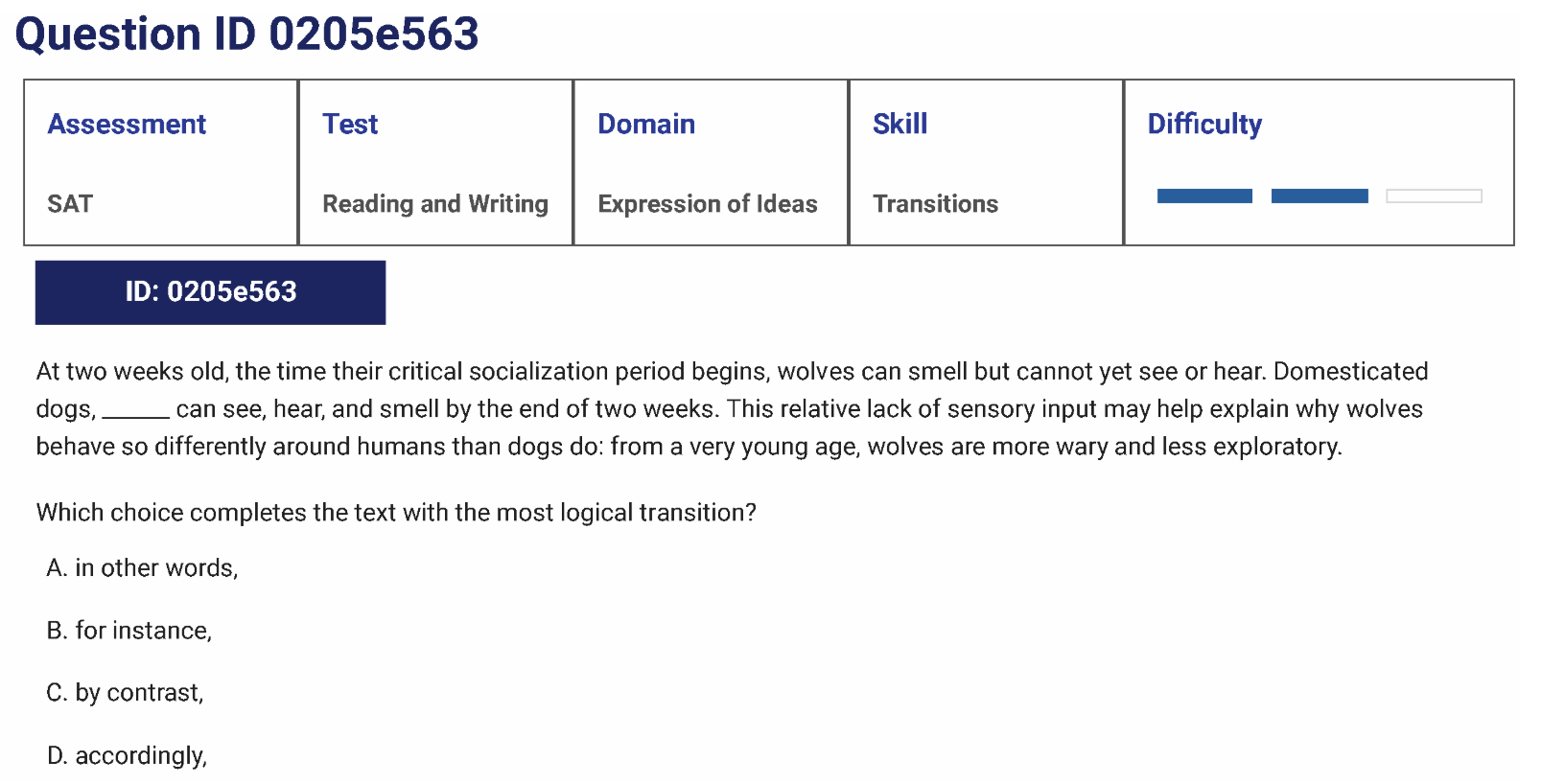 In the example above, the first sentence basically tells us that wolves can smell at 2 weeks old, but cannot see or hear. The second sentence tells us that dogs can see, hear, and smell after 2 weeks. Clearly, we are drawing a distinction between wolves and dogs here, so we need a transition word that does this. “By contrast” fits perfectly here. If you use CNTL+F and find each of the answer choices in the below guide, you can see what categories they fall into and what types of relationships they build between 2 sentences. If you struggle with transitions, I would recommend using this guide alongside practice problems to identify the role the transition needs to play. As an added benefit, as you get used to the meanings of these transitions and the categories they fall under, you will often be able to eliminate answer choices that play the same roll. ##### CATEGORY 1: "Also" — The next sentence adds more of the same idea Additionally, Besides, Furthermore, In addition, Indeed, Moreover, What's more, ##### CATEGORY 2: "For Example" — The next sentence is a specific example or detail For example, For instance, In fact, In particular, Specifically, That is, To be exact, ##### CATEGORY 3: "But" — The next sentence disagrees or goes the opposite direction By contrast, Conversely, However, In contrast, Instead, Nevertheless, Nonetheless, On the contrary, On the other hand, Still, ##### CATEGORY 4: "Okay, fair — but still..." — Admitting a point before pushing back ##### (These start by giving the other side credit, then disagree anyway) Admittedly, All the same, Granted, In any case, Of course, Regardless, That being said, That said, Though, ##### CATEGORY 5: "So" / "Because of this" — Cause and Effect ##### (The previous sentence caused or led to the next one) Accordingly, As a result, As such, Consequently, Fittingly, For this reason, Hence, In so doing, Therefore, Thus, To that end, With this in mind, ##### CATEGORY 6: "First / Next / Finally" — Listing things in order Finally, First, First of all, Firstly, In the first place, In the second place, In turn, Lastly, Next, Second, Second of all, Secondly, Then, ##### CATEGORY 7: "Before / After / Meanwhile" — Time is passing After, Afterward, Currently, Earlier, Eventually, Later, Meanwhile, Nowadays, Previously, Soon, Subsequently, Today, ##### CATEGORY 8: "In short" — Wrapping up or restating the main point In conclusion, In other words, In sum, In summary, To conclude, Ultimately, ##### CATEGORY 9: "Similarly" — Comparing two things that are alike Alternatively, Alternately, By comparison, In comparison, Likewise, Similarly, ##### CATEGORY 10: "Wait, actually..." — Correcting or reframing what was just said ##### (These signal: the reader assumed X, but the reality is Y) Actually, In reality, ##### CATEGORY 11: Frequency/How often something happens Again and again, In many cases, Increasingly, Intermittently, More often,

