The Grammar Questions you Keep Getting Wrong: Dangling Modifiers

Dangling Modifier Questions are the grammar section's toughest problems for most students. College Board refers to grammar questions as “Standard English Conventions”, and they make up 5-7 of the 27 questions in each module (usually starting at question 15 or 16 and going until 20-22).
These are the questions that ask:
“Which choice completes the text so that is conforms to the conventions of Standard English”
I cover a lot of the content needed to understand these questions in my other blog posts (see “A Painless Punctuation Guide for the SAT and a Couple Tips and Tricks”).
The type of problem I see the most students stumble on in this section is on dangling modifiers.
An example Problem straight out of the College Board Question Bank:

In this blog I will show you:
How to identify that you are being faced with a dangling modifiers question
How to never get them wrong
You must be able to identify a dangling modifier's problem instantly so that you know to access the right mindset to solve it. Learning how to solve it is super important, but if you don’t know it when you see it, you’ll waste valuable time.
Identification:
The question asked is “Which choice completes the text so that is conforms to the conventions of Standard English”
This establishes that we are dealing with a Grammar question (and we’re probably between questions 15-22 in the module)
The answer choices are relatively long and not similar
This is the telltale sign. Every other Grammar question (Standard English Convention) has short answer choices and/or very similar looking answer choices - the difference between them is often just punctuation or verb tense or something.
That’s it - if the problem meets those criteria, it is virtually guaranteed to be looking at a dangling modifiers problem.
How to Solve:
Let’s look back at the first example from above.

The thing that goes into the blank must start with a subject that is being talked about in the previous clause.
“Compared to that of alumna glass” must be followed immediately with the thing that the phrase is talking about!
We’re clearly talking about some property of alumina glass. It says “that of alumina glass” to indicate this. So, most likely, we are looking for some property of some other glass in the answer choices.
Choice D satisfies this.
If this isn’t totally clear yet, a few more practices and some pattern recognition will do the trick.
In the examples below, focus on the phrases right before the blank. They are all talking about something, but not telling us what that something is.
Look at the following 3 problems (also pulled from College Board):
Problem A

This one is talking about some “government body”. What is that government body? The answer must come immediately! Therefore, choice B is the only one that makes sense.
Problem B

This one tells us of “a pioneer”, without naming them. The correct choice must tell us who this mysterious pioneer is immediately. The only choice that starts with a name is B. You may be sensing how quickly these answers will come to you once you know what you’re looking for.
Problem C

This one tells us of someone who recovered. Who? Who recovered?
The choices tell us Henry recovered. Choice A.
Note: Choice C also starts by mentioning Henry, but the subject of that clause is “Henry’s reign”, not Henry. Henry’s reign did not recover, Henry did.
Final Tip:
As we have noted, the correct answer choice always begins with the subject that the opening phrase is referring to. You can always take that subject, bring it to the front of the sentence and read the sentence coherently.
From Problem B (correct choice B) can be rewritten as:
“Anna Behrensmeyer, a pioneer in the field of taphonomy (the study of how organic remains become fossils), demonstrated in a 2005 analysis that fossils of thin shelled organisms….”
From Problem C (correct choice A) can be rewritten as:
“Henry, upon recovering 2 years later, resumed his reign, forcing an angered….”
The format is: subject of correct answer + start of sentence + rest of correct answer + rest of sentence after the blank.
If structuring the sentence this way doesn’t make any sense, you probably have the wrong answer.
Here’s a few practice examples:
Problem D

Problem E
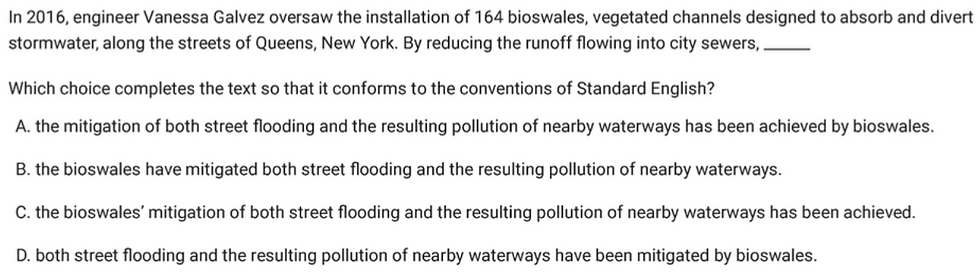
Problem F

Correct Answers:
Problem D: D
Problem E: B
Problem F: B